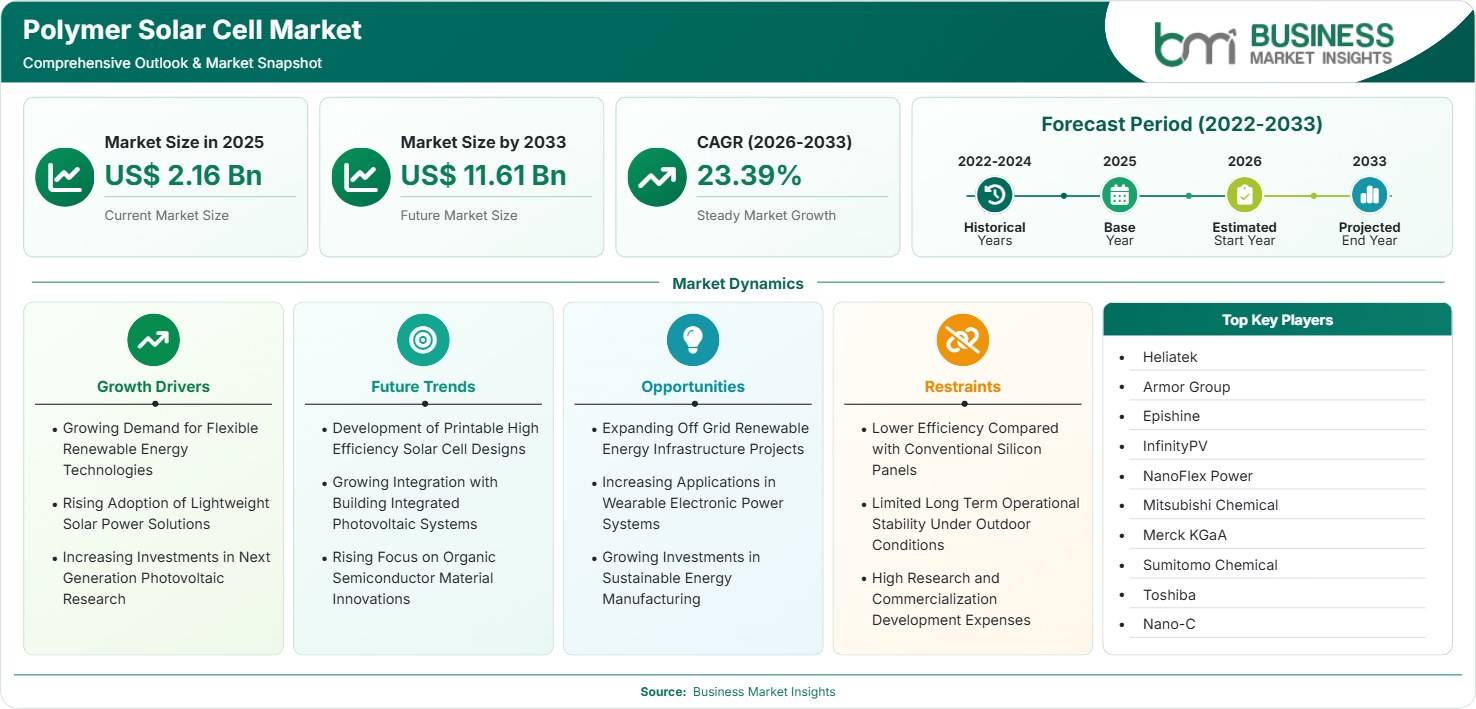
• Polymer Solar Cell Market Forecast to Surge to US$11.61 Billion by 2033 at 23.39% CAGR


    The Polymer Solar Cell Market size was valued at US$ 2.16 billion in 2025 and is projected to reach US$ 11.61 billion by 2033, growing at a CAGR of 23.39% during 2026–2033. The retrieved public source material for this batch did not expose all three headline values required for a verified numerical opening, so no market-size figure or CAGR is inferred.


    From the customer perspective, adoption depends on whether the solution improves a real operating outcome. Switching or upgrading becomes easier to justify when performance, reliability, safety, convenience, or total cost improves materially. The market context also includes industrial production, performance requirements, durability, process efficiency, specialty-material substitution, sustainability pressure, and demand for better lifecycle economics.


    https://www.businessmarketinsights.com/reports/polymer-solar-cell-market

    Polymer Solar Cell Market Forecast to Surge to US$11.61 Billion by 2033 at 23.39% CAGRThe Polymer Solar Cell Market size was valued at US$ 2.16 billion in 2025 and is projected to reach US$ 11.61 billion by 2033, growing at a CAGR of 23.39% during 2026–2033. The retrieved public source material for this batch did not expose all three headline values required for a verified numerical opening, so no market-size figure or CAGR is inferred.From the customer perspective, adoption depends on whether the solution improves a real operating outcome. Switching or upgrading becomes easier to justify when performance, reliability, safety, convenience, or total cost improves materially. The market context also includes industrial production, performance requirements, durability, process efficiency, specialty-material substitution, sustainability pressure, and demand for better lifecycle economics.https://www.businessmarketinsights.com/reports/polymer-solar-cell-market
    WWW.BUSINESSMARKETINSIGHTS.COM
    Polymer Solar Cell Market Trends, Demand & Growth by 2033
    Polymer Solar Cell market is expected to surpass US$ 11.61 Billion by 2033, growing at a CAGR of 23.39%. Explore growth insights & forecast.
    0 Comentários 0 Compartilhamentos 271 Visualizações 0 Anterior
  • Epigenomics Market Estimated to Experience a Hike in Growth by 2035

    A recently published research report on the Epigenomics Market delivers a thorough analysis of historical trends and future projections till 2035. The article offers an overview of how the market has evolved in terms of size, structure, and geographic performance. It presents factual insights into how various regions and application areas have contributed to the overall expansion of this market in recent years.


    The global epigenomics market, valued at USD 1.98 billion in 2024, is projected to reach USD 2.32 billion in 2025 and USD 8.49 billion by 2035, representing a CAGR of 13.8% during the forecast period. The research takes a grounded approach in presenting its findings, focusing on performance indicators across segments and territories without making speculative claims. Key developments, general industry behavior, and practical observations form the basis of the market forecast provided within this article.


    The article segments the market by Distribution by Historical Trend: Since 2020, Forecast Period: Till 2035, Market Size 2025: USD 2.32 Billion, Market Size 2035: USD 8.49 Billion, CAGR till 2035: 13.8%, Type of Product, Reagents, Kits, ( Instruments, Enzymes, Services, Type of Component, Methylation, Acetylation, Phosphorylation, Ubiquitylation, Sumoylation, Type of Technology, DNA Methylation, Histone Methylation, Histone Acetylation, Large Non-Coding RNA, Microrna Modification, Chromatin Structures, Application Area, Oncology, ( Non-Oncology, ( End-Users, Academic Research, Clinical Research, Hospitals & Clinics, Pharmaceutical & Biotechnology Companies, Other End Users, Geographical Regions, North America, ( Europe, ( Asia-Pacific, ( Middle East and North Africa, ( Latin America, ( Key Companies Profiled, Abcam, Active Motif, Bio-Rad Laboratories, Diagenode, Illumina, Merck, New England Biolabs, PacBio, Promega, PerkinElmer, Roche, Qiagen, Thermo Fisher Scientific, Zymo Research, PowerPoint Presentation(Complimentary): Available, Customization Scope: 15% Free Customization, Excel Data Packs(Complimentary): Available.


    Key Geographies


    North America, ( US, Canada, Mexico), Europe, ( France, Germany, Italy, Spain, UK and Rest of Europe), Asia-Pacific, ( China, India, Japan, South Korea, and Rest of Asia-Pacific), Middle East and North Africa, ( Egypt, Saudi Arabia and United Arab Emirates), Latin America, ( Argentina and Brazil)


    Geographic segmentation includes revenue performance and estimated demand across each of these key regions. The analysis reviews how various territories contribute to the Epigenomics Market share and what role regional market conditions may play in shaping future growth. Without introducing speculative drivers, the research presents regional estimates based on verified indicators and current availability of products and infrastructure.


    Origin of Information: https://www.rootsanalysis.com/reports/epigenomics-market.html</p>


    A core section of the report profiles some of the top companies in Epigenomics. These include Abcam, Active Motif, Bio-Rad Laboratories, Diagenode, Illumina, Merck, New England Biolabs, PacBio, Promega, PerkinElmer, Roche, Qiagen, Thermo Fisher Scientific, Zymo Research. The article reviews their regional presence, product strategy, and manufacturing or distribution strengths. The focus remains on factual descriptions of business operations and their contributions to the broader Epigenomics Market growth. While market positions may differ, each company’s strategic alignment, sales footprint, and application coverage are considered as part of the competitive assessment.


    Additional insights include a review of pricing trends, supplier relationships, cost structures, and how materials flow across production stages. The research highlights interactions between upstream and downstream segments, giving readers a view into the broader functioning of the Epigenomics industry. These insights are grounded in observed practices and data rather than hypothetical or promotional interpretations.


    Strategic developments such as acquisitions, expansions, and regional market entries are also included in the analysis. The article outlines these shifts in the context of their immediate impact, without speculating on long-term consequences or performance outcomes. Information is included to help readers understand where the industry is today and how recent activity reflects changing market priorities.


    Epigenomics Market Estimated to Experience a Hike in Growth by 2035A recently published research report on the Epigenomics Market delivers a thorough analysis of historical trends and future projections till 2035. The article offers an overview of how the market has evolved in terms of size, structure, and geographic performance. It presents factual insights into how various regions and application areas have contributed to the overall expansion of this market in recent years.The global epigenomics market, valued at USD 1.98 billion in 2024, is projected to reach USD 2.32 billion in 2025 and USD 8.49 billion by 2035, representing a CAGR of 13.8% during the forecast period. The research takes a grounded approach in presenting its findings, focusing on performance indicators across segments and territories without making speculative claims. Key developments, general industry behavior, and practical observations form the basis of the market forecast provided within this article.The article segments the market by Distribution by Historical Trend: Since 2020, Forecast Period: Till 2035, Market Size 2025: USD 2.32 Billion, Market Size 2035: USD 8.49 Billion, CAGR till 2035: 13.8%, Type of Product, Reagents, Kits, ( Instruments, Enzymes, Services, Type of Component, Methylation, Acetylation, Phosphorylation, Ubiquitylation, Sumoylation, Type of Technology, DNA Methylation, Histone Methylation, Histone Acetylation, Large Non-Coding RNA, Microrna Modification, Chromatin Structures, Application Area, Oncology, ( Non-Oncology, ( End-Users, Academic Research, Clinical Research, Hospitals & Clinics, Pharmaceutical & Biotechnology Companies, Other End Users, Geographical Regions, North America, ( Europe, ( Asia-Pacific, ( Middle East and North Africa, ( Latin America, ( Key Companies Profiled, Abcam, Active Motif, Bio-Rad Laboratories, Diagenode, Illumina, Merck, New England Biolabs, PacBio, Promega, PerkinElmer, Roche, Qiagen, Thermo Fisher Scientific, Zymo Research, PowerPoint Presentation(Complimentary): Available, Customization Scope: 15% Free Customization, Excel Data Packs(Complimentary): Available.Key Geographies North America, ( US, Canada, Mexico), Europe, ( France, Germany, Italy, Spain, UK and Rest of Europe), Asia-Pacific, ( China, India, Japan, South Korea, and Rest of Asia-Pacific), Middle East and North Africa, ( Egypt, Saudi Arabia and United Arab Emirates), Latin America, ( Argentina and Brazil)Geographic segmentation includes revenue performance and estimated demand across each of these key regions. The analysis reviews how various territories contribute to the Epigenomics Market share and what role regional market conditions may play in shaping future growth. Without introducing speculative drivers, the research presents regional estimates based on verified indicators and current availability of products and infrastructure.Origin of Information: https://www.rootsanalysis.com/reports/epigenomics-market.htmlA core section of the report profiles some of the top companies in Epigenomics. These include Abcam, Active Motif, Bio-Rad Laboratories, Diagenode, Illumina, Merck, New England Biolabs, PacBio, Promega, PerkinElmer, Roche, Qiagen, Thermo Fisher Scientific, Zymo Research. The article reviews their regional presence, product strategy, and manufacturing or distribution strengths. The focus remains on factual descriptions of business operations and their contributions to the broader Epigenomics Market growth. While market positions may differ, each company’s strategic alignment, sales footprint, and application coverage are considered as part of the competitive assessment.Additional insights include a review of pricing trends, supplier relationships, cost structures, and how materials flow across production stages. The research highlights interactions between upstream and downstream segments, giving readers a view into the broader functioning of the Epigenomics industry. These insights are grounded in observed practices and data rather than hypothetical or promotional interpretations.Strategic developments such as acquisitions, expansions, and regional market entries are also included in the analysis. The article outlines these shifts in the context of their immediate impact, without speculating on long-term consequences or performance outcomes. Information is included to help readers understand where the industry is today and how recent activity reflects changing market priorities.
    WWW.ROOTSANALYSIS.COM
    File not found page redirect
    You've reached a page that doesn't exist. Redirecting you to the homepage of Roots Analysis.
    0 Comentários 0 Compartilhamentos 611 Visualizações 0 Anterior
  • Photodynamic Market Estimated to Experience a Hike in Growth by 2035

    The report titled ‘Photodynamic Therapy Market’ delivers a structured overview of how the industry has progressed over the years, along with expectations for future movement till 2035. This report evaluates changes in the market size and highlights important developments within the industry. It offers clarity on regional patterns, key segments, and broader structural shifts without relying on speculative forecasting.


    The global photodynamic therapy market, valued at USD 672 million in 2025 , is projected to reach USD 749 million in 2026 and USD 1,532 million by 2035 , representing a CAGR of 8.3% during the forecast period 2026 to 2035. These projections are supported by current and historical performance metrics, highlighting regional and segment-level shifts across the global landscape. The study also outlines some of the major challenges and approaches being used across industry to adapt to evolving market conditions. The market forecast section provides a grounded view of potential movements over time, based on verified data and observed patterns.


    This report includes a complete segmentation of the Photodynamic Therapy Market. The segmentation is based on Distribution by Historical Trend: Since 2021, Forecast Period: Till 2035, Market Size 2026: $ 749 Million, Market Size 2035: $ 1,532 Million, CAGR (Till 2035): 8.3%, Segments Covered, Target Indication, Therapeutic Area, Key Geographical Regions.


    Key Geographies


    In addition to a high-level overview, the report also discusses market share shifts across these regions and the economic performance within each geography. It presents reliable estimates of projected revenue and market contribution, maintaining a neutral stance on causal relationships or future assumptions. Emphasis is placed on identifying key structural elements influencing Photodynamic Therapy Market growth across different regional and application-based divisions. [Origin of Information: https://www.rootsanalysis.com/reports/light-activated-therapies-market.html]


    The report features a detailed assessment of leading market participants, highlighting companies such as ADVANZ PHARMA, Biofrontera, Biolitec Pharma, Galderma, Luzitin, Nanospectra Biosciences, Novartis, Rakuten Medical, Impact Biotech, Theralase. These companies have been profiled based on product focus, regional activity, and general business operations. The section on top companies in Photodynamic Therapy Market also evaluates how these firms have positioned themselves in response to market shifts, and how their current portfolios align with observed demand.


    Additional insights include the review of pricing models, cost structures, and supply chain operations relevant to the Photodynamic Therapy Market. The report includes discussion on raw material access, cost flow, distribution patterns, and processing rates, offering a deeper look at how value is created and maintained across different stages of production and delivery.


    The study also references recent strategic activities such as acquisitions, product launches, and geographic expansions. These developments are discussed in the context of how they impact competitive intensity and operational shifts within the Photodynamic Therapy Market. The analysis remains factual, highlighting observed actions without assigning subjective or future-looking projections.


    Research Methodology

    The methodology for this report includes both primary and secondary data collection from credible industry sources. Analysts have compiled information from public filings, interviews, industry portals, and market databases to ensure a high standard of accuracy. This approach ensures that the data used in the Photodynamic Therapy Market analysis is robust and suitable for industry decision-making.


    For any questions or to request a customized version of this report, please contact our team. We’re available to help tailor the study to your specific needs and areas of interest.

    Photodynamic Market Estimated to Experience a Hike in Growth by 2035The report titled ‘Photodynamic Therapy Market’ delivers a structured overview of how the industry has progressed over the years, along with expectations for future movement till 2035. This report evaluates changes in the market size and highlights important developments within the industry. It offers clarity on regional patterns, key segments, and broader structural shifts without relying on speculative forecasting.The global photodynamic therapy market, valued at USD 672 million in 2025 , is projected to reach USD 749 million in 2026 and USD 1,532 million by 2035 , representing a CAGR of 8.3% during the forecast period 2026 to 2035. These projections are supported by current and historical performance metrics, highlighting regional and segment-level shifts across the global landscape. The study also outlines some of the major challenges and approaches being used across industry to adapt to evolving market conditions. The market forecast section provides a grounded view of potential movements over time, based on verified data and observed patterns.This report includes a complete segmentation of the Photodynamic Therapy Market. The segmentation is based on Distribution by Historical Trend: Since 2021, Forecast Period: Till 2035, Market Size 2026: $ 749 Million, Market Size 2035: $ 1,532 Million, CAGR (Till 2035): 8.3%, Segments Covered, Target Indication, Therapeutic Area, Key Geographical Regions.Key GeographiesIn addition to a high-level overview, the report also discusses market share shifts across these regions and the economic performance within each geography. It presents reliable estimates of projected revenue and market contribution, maintaining a neutral stance on causal relationships or future assumptions. Emphasis is placed on identifying key structural elements influencing Photodynamic Therapy Market growth across different regional and application-based divisions. [Origin of Information: https://www.rootsanalysis.com/reports/light-activated-therapies-market.html]The report features a detailed assessment of leading market participants, highlighting companies such as ADVANZ PHARMA, Biofrontera, Biolitec Pharma, Galderma, Luzitin, Nanospectra Biosciences, Novartis, Rakuten Medical, Impact Biotech, Theralase. These companies have been profiled based on product focus, regional activity, and general business operations. The section on top companies in Photodynamic Therapy Market also evaluates how these firms have positioned themselves in response to market shifts, and how their current portfolios align with observed demand.Additional insights include the review of pricing models, cost structures, and supply chain operations relevant to the Photodynamic Therapy Market. The report includes discussion on raw material access, cost flow, distribution patterns, and processing rates, offering a deeper look at how value is created and maintained across different stages of production and delivery.The study also references recent strategic activities such as acquisitions, product launches, and geographic expansions. These developments are discussed in the context of how they impact competitive intensity and operational shifts within the Photodynamic Therapy Market. The analysis remains factual, highlighting observed actions without assigning subjective or future-looking projections.Research MethodologyThe methodology for this report includes both primary and secondary data collection from credible industry sources. Analysts have compiled information from public filings, interviews, industry portals, and market databases to ensure a high standard of accuracy. This approach ensures that the data used in the Photodynamic Therapy Market analysis is robust and suitable for industry decision-making.For any questions or to request a customized version of this report, please contact our team. We’re available to help tailor the study to your specific needs and areas of interest.
    WWW.ROOTSANALYSIS.COM
    File not found page redirect
    You've reached a page that doesn't exist. Redirecting you to the homepage of Roots Analysis.
    Like
    1
    0 Comentários 0 Compartilhamentos 700 Visualizações 0 Anterior
  • Monoclonal Antibody Markets Estimated to Experience a Hike in Growth by 2035

    A recently published research report on the Monoclonal Antibody Market delivers a thorough analysis of historical trends and future projections till 2035. The article offers an overview of how the market has evolved in terms of size, structure, and geographic performance. It presents factual insights into how various regions and application areas have contributed to the overall expansion of this market in recent years.


    The research takes a grounded approach in presenting its findings, focusing on performance indicators across segments and territories without making speculative claims. Key developments, general industry behavior, and practical observations form the basis of the market forecast provided within this article.


    The article segments the market by Distribution by Historical Trend: Since 2020, Forecast Period: Till 2035, Market Size 2025: USD 283.86 Billion, Market Size 2035: USD 816.33 Billion, CAGR (Till 2035): 11.1%.


    Key Geographies


    Geographic segmentation includes revenue performance and estimated demand across each of these key regions. The analysis reviews how various territories contribute to the Monoclonal Antibody Market share and what role regional market conditions may play in shaping future growth. Without introducing speculative drivers, the research presents regional estimates based on verified indicators and current availability of products and infrastructure.


    Origin of Information: https://www.rootsanalysis.com/reports/monoclonal-antibody-market.html</p>


    A core section of the report profiles some of the top companies in Monoclonal Antibody. These include Amgen (US), Abbott Laboratories (US), AstraZeneca (UK), Bayer (Germany), Bristol Myers Squibb (US), Biogen (US), Daiichi Sankyo Company (Japan), Eli Lilly (US), GlaxoSmithKline (UK), Johnson & Johnson (US), Merck (US), Novartis (Switzerland), Novo Nordisk (Denmark), Pfizer (US), Roche (Switzerland), Sanofi (France), Thermo Fisher Scientific (US), Viatris (US). The article reviews their regional presence, product strategy, and manufacturing or distribution strengths. The focus remains on factual descriptions of business operations and their contributions to the broader Monoclonal Antibody Market growth. While market positions may differ, each company’s strategic alignment, sales footprint, and application coverage are considered as part of the competitive assessment.


    Additional insights include a review of pricing trends, supplier relationships, cost structures, and how materials flow across production stages. The research highlights interactions between upstream and downstream segments, giving readers a view into the broader functioning of the Monoclonal Antibody industry. These insights are grounded in observed practices and data rather than hypothetical or promotional interpretations.


    Strategic developments such as acquisitions, expansions, and regional market entries are also included in the analysis. The article outlines these shifts in the context of their immediate impact, without speculating on long-term consequences or performance outcomes. Information is included to help readers understand where the industry is today and how recent activity reflects changing market priorities.


    Research Methodology

    The research team employed a combination of primary and secondary data sources to compile this report. Sources include public filings, interviews, industry databases, and internal assessments. All information presented has been reviewed for accuracy and consistency. This approach ensures a balanced understanding of the biopesticides industry for readers seeking reliable and actionable insights.


    For further clarification or to request a customized version of this report, feel free to reach out. Our team is ready to help with any specific business needs related to the Monoclonal Antibody Market.

    Monoclonal Antibody Markets Estimated to Experience a Hike in Growth by 2035A recently published research report on the Monoclonal Antibody Market delivers a thorough analysis of historical trends and future projections till 2035. The article offers an overview of how the market has evolved in terms of size, structure, and geographic performance. It presents factual insights into how various regions and application areas have contributed to the overall expansion of this market in recent years. The research takes a grounded approach in presenting its findings, focusing on performance indicators across segments and territories without making speculative claims. Key developments, general industry behavior, and practical observations form the basis of the market forecast provided within this article.The article segments the market by Distribution by Historical Trend: Since 2020, Forecast Period: Till 2035, Market Size 2025: USD 283.86 Billion, Market Size 2035: USD 816.33 Billion, CAGR (Till 2035): 11.1%.Key GeographiesGeographic segmentation includes revenue performance and estimated demand across each of these key regions. The analysis reviews how various territories contribute to the Monoclonal Antibody Market share and what role regional market conditions may play in shaping future growth. Without introducing speculative drivers, the research presents regional estimates based on verified indicators and current availability of products and infrastructure.Origin of Information: https://www.rootsanalysis.com/reports/monoclonal-antibody-market.htmlA core section of the report profiles some of the top companies in Monoclonal Antibody. These include Amgen (US), Abbott Laboratories (US), AstraZeneca (UK), Bayer (Germany), Bristol Myers Squibb (US), Biogen (US), Daiichi Sankyo Company (Japan), Eli Lilly (US), GlaxoSmithKline (UK), Johnson & Johnson (US), Merck (US), Novartis (Switzerland), Novo Nordisk (Denmark), Pfizer (US), Roche (Switzerland), Sanofi (France), Thermo Fisher Scientific (US), Viatris (US). The article reviews their regional presence, product strategy, and manufacturing or distribution strengths. The focus remains on factual descriptions of business operations and their contributions to the broader Monoclonal Antibody Market growth. While market positions may differ, each company’s strategic alignment, sales footprint, and application coverage are considered as part of the competitive assessment.Additional insights include a review of pricing trends, supplier relationships, cost structures, and how materials flow across production stages. The research highlights interactions between upstream and downstream segments, giving readers a view into the broader functioning of the Monoclonal Antibody industry. These insights are grounded in observed practices and data rather than hypothetical or promotional interpretations.Strategic developments such as acquisitions, expansions, and regional market entries are also included in the analysis. The article outlines these shifts in the context of their immediate impact, without speculating on long-term consequences or performance outcomes. Information is included to help readers understand where the industry is today and how recent activity reflects changing market priorities.Research MethodologyThe research team employed a combination of primary and secondary data sources to compile this report. Sources include public filings, interviews, industry databases, and internal assessments. All information presented has been reviewed for accuracy and consistency. This approach ensures a balanced understanding of the biopesticides industry for readers seeking reliable and actionable insights.For further clarification or to request a customized version of this report, feel free to reach out. Our team is ready to help with any specific business needs related to the Monoclonal Antibody Market.
    WWW.ROOTSANALYSIS.COM
    File not found page redirect
    You've reached a page that doesn't exist. Redirecting you to the homepage of Roots Analysis.
    Like
    1
    0 Comentários 2 Compartilhamentos 1K Visualizações 0 Anterior