
Integrate GEO Services Without Fragmented US Pages
For digital marketing agencies serving clients across the United States, regional visibility can get messy fast. Pages for different cities may repeat the same copy, list conflicting contact details, or answer questions local customers do not ask. Integrating GEO services means planning Generative Engine Optimization alongside local SEO and Answer Engine Optimization, so regional information is clear, useful, and consistent wherever people search.
The work starts with audience needs, not a batch of city pages. Map the markets that matter, understand what people in each market need to know, then connect content planning with accurate location details and a practical measurement plan. That gives client brands a better foundation for being found and understood across search results, maps, and AI-generated answers, without promising a particular ranking or citation.
Why GEO services break across United States markets
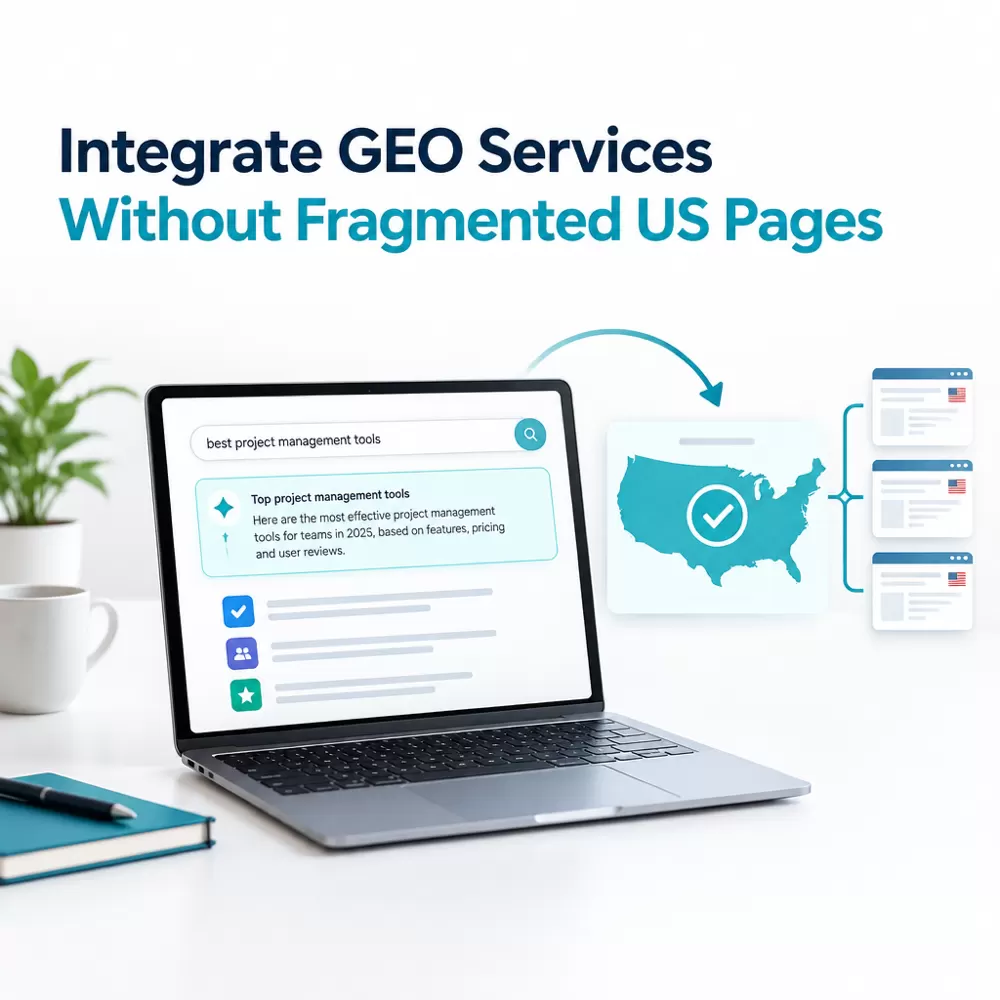
Regional content often grows by accumulation. A client adds a new service area, the agency publishes a location page, and another team updates a directory listing. Over time, pages can drift apart. One may describe a service the business no longer offers, while another shows an outdated phone number or an address that is not a staffed location.
These are not just editorial oversights. Searchers use location information to decide whether a business is relevant and reachable. Search engines and answer systems also need clear, consistent information to interpret a brand. If regional pages are thin or contradictory, adding more of them may increase maintenance work without helping customers make a decision.
Start by separating three kinds of information:
- Business facts: The official name, phone number, address where applicable, hours, service list, and service-area boundaries.
- Market details: The locations served, local terminology, seasonal considerations, and practical differences in how a service is delivered.
- Audience questions: What customers need to know before they contact, visit, or choose the business.
For businesses eligible for a Google Business Profile, review the profile alongside the website and other important listings. Keep name, address, and phone number details, often shortened to NAP, consistent wherever they are published. Service-area businesses should describe their coverage accurately rather than implying they have staffed offices in every city. Local accuracy builds trust; it is not a reason to create a location claim the business cannot support.
Map priority markets and make regional content useful
Agencies do not need to publish a page for every place a client could theoretically serve. First, map markets against business priorities and real operating capacity. Consider where the client has a physical presence, where staff can reliably provide service, which markets are strategically important, and where customer demand or sales conversations point to unanswered questions. Confirm the client can actually serve each proposed location before adding it to a plan.
Then build a question map for each priority market. Use sales and support conversations, client interviews, and relevant search queries to identify what people ask. A customer comparing providers may want to know about availability, service boundaries, scheduling, local requirements, or what happens after an inquiry. The specific questions will vary by industry and market, so validate them with the client instead of assuming every city has the same needs.
Use those findings to decide what belongs on a regional page and what should stay on a central service page. A regional page earns its place when it adds useful, verifiable detail, such as a genuinely different service process, local operating hours, a real nearby office, or clear coverage information. If the offer and customer questions are identical across locations, a strong central page with transparent service-area information may be more useful than many near-duplicate pages.
Useful local content should answer the question directly, explain what applies in that market, and make the next step clear. Avoid swapping city names into a template while leaving generic claims untouched. Do not invent local projects, staff, testimonials, or community ties to make a page feel specific. Where there is no meaningful local difference, say so plainly and link the reader to the relevant service information on the site, without manufacturing a distinction.
For local discovery, check that the business’s Google Business Profile, where eligible, reflects accurate categories, hours, service details, and coverage. Reviews can help prospective customers assess fit, but agencies should not script misleading reviews or treat review volume as a substitute for accurate information. Monitor the map pack and “near me” searches as part of the broader picture, while remembering that visibility varies by searcher location, query, and competition.
Connect regional planning to SEO, AEO, and GEO support
Regional content works best when it is part of a coordinated search strategy. SEO covers the site’s ability to be crawled, understood, and surfaced for relevant searches. AEO, or Answer Engine Optimization, focuses on making useful answers easy to identify in search experiences that respond directly to questions. GEO, or Generative Engine Optimization, applies that clarity to the way generative systems may interpret and summarize brand information. None of these disciplines guarantees a ranking, a featured answer, or an AI citation.
For agencies reviewing their delivery model, how can digital marketing agencies integrate geo services to boost client brand visibility? guide describes integrated SEO, AEO, and GEO support for agency work. The useful planning question is how those capabilities fit the client’s regional priorities: technical fixes may help search engines access important pages, while accurate location details and well-structured, direct content help people and systems understand what the business offers.
Before publishing, run a simple quality check. Confirm that each page serves a defined audience or business purpose, the location details match the client’s source of truth, and the content answers a real question. Check for duplicated paragraphs, unsupported claims, broken internal paths, and inconsistencies with the Google Business Profile or key listings. Assign an owner and review date for details that can change, such as hours, coverage, or service availability.
Measure the work against its intended role. Track organic visibility and relevant landing-page engagement, local profile interactions where applicable, and the quality of inquiries from priority markets. Review whether visitors reach useful service information and whether the content addresses questions raised by sales or support teams. For AEO and GEO, assess whether brand information is accurate and clear in the search experiences you monitor, but treat observed appearances as signals, not guaranteed outcomes.
A practical next step is to audit one client and a small set of priority markets before expanding the program. List existing pages and location references, note conflicts, collect recurring customer questions, then decide which pages need revision and which should not exist. This keeps regional content tied to genuine audience needs and gives the agency a clear basis for reporting. Expand only when the client can maintain the information and the new market has a distinct reason to be covered.
More location pages do not automatically mean more visibility. Start with accurate facts and real market questions, then publish only the regional content that helps a customer make a decision.
 English
 Arabic
 French
 Spanish
 Portuguese
 Deutsch
 Turkish
 Dutch
 Italiano
 Russian
 Romaian
 Portuguese (Brazil)
 Greek