
Middle East Fertilizer Market 2026 | Growth, Trends, and Forecast by 2034
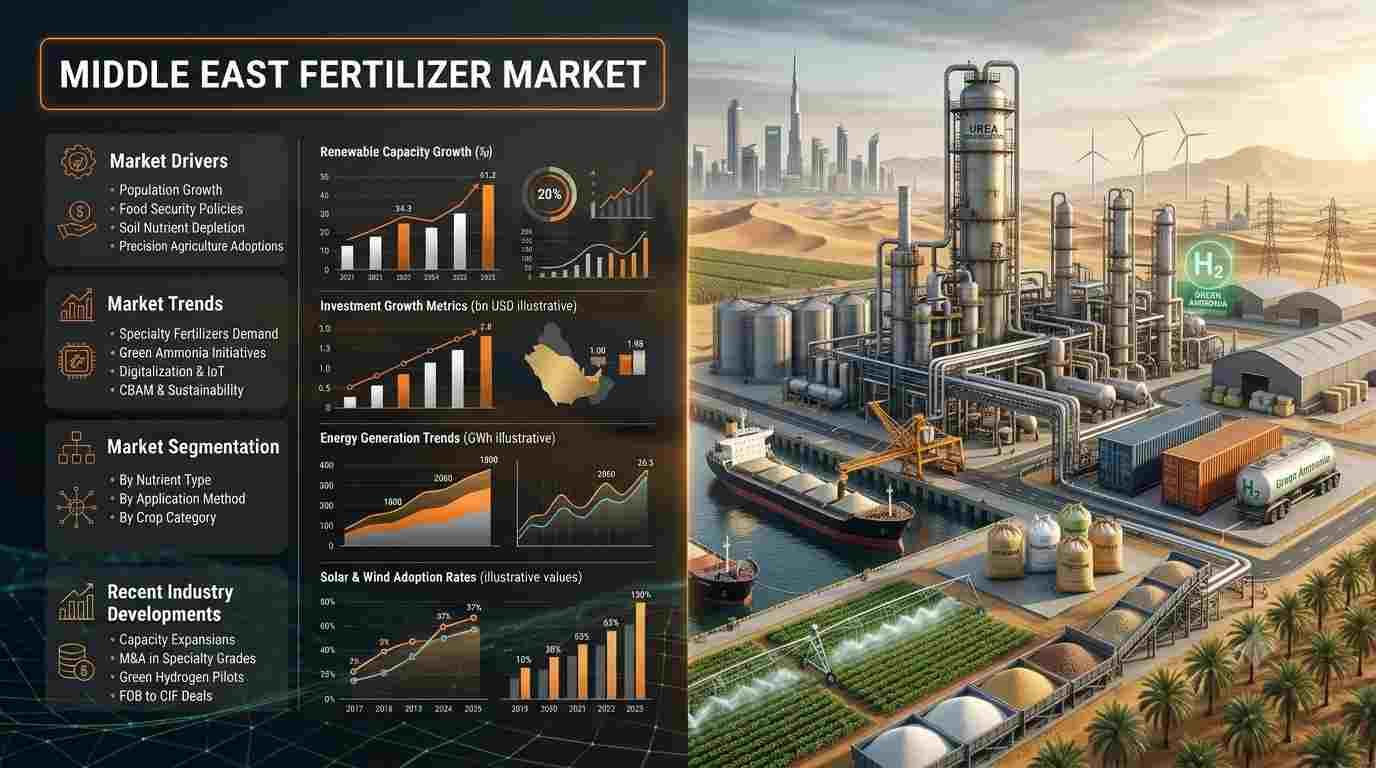
IMARC Group, a leading global market research and management consulting firm, has published its latest market intelligence report on the Middle East Fertilizer Market. The Middle East fertilizer market size reached USD 8,627.2 Million in 2025 and is projected to reach USD 15,366.5 Million by 2034, exhibiting a CAGR of 6.62% during 2026-2034. Growth is being driven by the growing consumption of high-quality fruits and vegetables to maintain a balanced diet, increasing research and development activities to formulate effective fertilizer forms, and the rising popularity of precision agriculture.
Fertilizers are among the most strategically important agricultural inputs in the Middle East, supplying the nitrogen, phosphorus, potassium and micronutrients that enhance soil fertility, raise crop yields and improve crop quality. They range from nitrogen-based fertilizers such as urea and ammonium nitrate, to phosphatic products such as DAP and TSP, potash products and balanced complex fertilizers, available in dry and water-soluble forms. As Gulf governments push ahead with food security and economic diversification programs, regional demand is being supported by a rising focus on food security, precision agriculture and sustainable practices, including biofertilizers and organic fertilizers that minimize nutrient leaching. At the same time, the region is home to some of the world's largest fertilizer producers, making it important both as a consumer and as a global supplier. Combined, these forces are reshaping the competitive landscape across Saudi Arabia, the UAE, Qatar, Oman, Turkey, Israel and the wider region.
Middle East Fertilizer Market at a Glance:
- Market Size (2025): USD 8,627.2 Million
- Market Forecast (2034): USD 15,366.5 Million
- Growth Rate (2026-2034): CAGR of 6.62%
- Base Year: 2025 | Historical Period: 2020-2025 | Forecast Period: 2026-2034
How AI is Reshaping the Future of the Middle East Fertilizer Market
- AI-Based Soil Analysis and Precision Input Use: Strategy& analysis of AI in Gulf agriculture highlights AI-based soil analysis that evaluates soil health and fertility from sensor or satellite data, and precision agriculture that uses satellite imagery, drones and sensors to optimize water, fertilizer and pesticide use. Systems that integrate soil-moisture sensors with weather forecasting can cut irrigation water use by 30 to 60 percent in some cases.
- Government-Backed Smart Farming in Saudi Arabia: Saudi Arabia's Ministry of Environment, Water and Agriculture is reported to promote digital agriculture through smart farming pilots, demonstration farms and extension programs that encourage farmers to adopt sensor-based irrigation and AI-enabled decision tools, supported by events such as the Saudi Smart Agriculture and Drone Exhibition.
- Variable-Rate Nutrient Application Research: In April 2026, KAUST's Center of Excellence for Sustainable Food Security hosted a seminar on AI and robotics for sustainable food production in extreme environments, covering technologies that enable variable-rate nutrient application, early stress detection and yield forecasting, with particular relevance to regions such as Saudi Arabia.
Grab a sample PDF of this report: https://www.imarcgroup.com/middle-east-fertilizer-market/requestsample
Middle East Fertilizer Market Trends and Drivers:
Demand for fertilizers across the Middle East is being underpinned by the rising consumption of high-quality fruits and vegetables and a stronger focus on food security. Consumers are paying closer attention to balanced diets and the prevention of chronic ailments, while governments are working to raise domestic production, and fertilizers are central to lifting crop yield and nutritional quality. In Saudi Arabia, for example, the agriculture ministry has been cited as noting that the Kingdom imports around 80 percent of its food requirements, which adds urgency to expanding local production.
The region's structural differentiator is its dual role as a major consumer and a global supplier. Gulf producers are estimated to provide 30 to 35 percent of global urea exports and 20 to 30 percent of ammonia exports according to FAO analysis, built on low-cost natural gas and phosphate resources. Producers are also focusing on customized fertilizer mixes tailored to the requirements of specific plants, supported by research and development activities that formulate more effective fertilizer forms.
A third driver is the shift toward precision agriculture and sustainable practices. Precision techniques use real-time data, soil analysis and satellite imagery to apply fertilizers more accurately, improving efficiency and minimizing environmental impact, while concerns about nutrient runoff and greenhouse gas emissions are encouraging farmers to adopt biofertilizers and organic fertilizers, a dynamic that is set to intensify over the coming decade.
Government Schemes and National Programs Driving Demand:
- Saudi Vision 2030 Mining and Industrial Diversification: Saudi Arabia is capitalizing on its phosphate reserves to diversify away from oil under Vision 2030. Ma'aden's USD 6.4 billion Phosphate 3 expansion is designed to add 3 million tonnes of phosphate fertilizer capacity, taking total capacity above 9 million tonnes, with USD 921 million of contracts awarded in January 2025 and a support agreement signed with the Ministry of Investment.
- Saudi Gas Feedstock Allocation for Urea Expansion: In March 2026, the Saudi energy ministry approved a gas feedstock allocation that allows SABIC Agri-Nutrients to advance plans to add 2.6 million tonnes per year of urea capacity.
- UAE National Food Security Strategy 2051: The strategy aims to make the UAE the world's best in the Global Food Security Index by 2051, with emphasis on diversifying food import sources, enhancing local production, reducing waste and using modern technologies for sustainable production.
- UAE National Initiative for the Adoption of Climate-Smart Crops: Launched on 26 April 2026 by the Ministry of Climate Change and Environment with the International Centre for Biosaline Agriculture, the initiative aims to improve self-sufficiency in food and animal feed production, focusing on four salt-tolerant crops that can grow on salt-affected land using non-conventional water sources.
Middle East Fertilizer Industry Segmentation:
The report has segmented the market into the following categories:
Breakup By Product Type:
- Chemical Fertilizer
- Biofertilizers
The report provides a detailed breakup and analysis of the market by product type, covering chemical fertilizers and biofertilizers, with eco-friendly biofertilizers gaining attention as farmers seek to minimize nutrient leaching and adopt sustainable practices.
Breakup By Product:
- Straight Fertilizers (Nitrogenous: Urea, Calcium Ammonium Nitrate, Ammonium Nitrate, Ammonium Sulfate, Anhydrous Ammonia; Phosphatic: MAP, DAP, SSP, TSP; Potash: MoP, SoP; Secondary Macronutrient and Micronutrient Fertilizers)
- Complex Fertilizers
The report provides a detailed breakup and analysis of the market by product. Nitrogen-based fertilizers promote leafy growth and overall plant development, phosphorus-based fertilizers support root development and flowering, and potassium-based fertilizers are vital for overall plant health, while complex fertilizers provide a balanced nutrient supply in varying NPK ratios.
Breakup By Product Form:
- Dry
- Liquid
The report provides a detailed breakup and analysis of the market by product form, covering dry fertilizers and water-soluble liquid formulations that ensure quick nutrient absorption by plants.
Breakup By Crop Type:
- Grains and Cereals
- Pulses and Oilseeds
- Fruits and Vegetables
- Flowers and Ornamentals
- Others
The report provides a detailed breakup and analysis of the market by crop type, with rising consumption of high-quality fruits and vegetables among the factors supporting fertilizer demand across crop categories.
Breakup By Country:
- Saudi Arabia
- Turkey
- Israel
- United Arab Emirates
- Iran
- Iraq
- Qatar
- Kuwait
- Oman
- Jordan
- Bahrain
- Others
The report provides a comprehensive analysis of all the major country markets, spanning large fertilizer-producing economies such as Saudi Arabia, Qatar, the UAE and Oman as well as sizeable agricultural consumers such as Turkey, Israel, Iraq and Jordan.
Competitive Landscape:
The report provides a comprehensive analysis of the competitive landscape in the Middle East fertilizer market, covering market structure, key player positioning, top winning strategies, a competitive dashboard and a company evaluation quadrant. Detailed profiles of all major companies are also included. Key market players are focusing on manufacturing customized fertilizer mixes tailored to the specific requirements of plants, investing in research and development, and expanding capacity in nitrogen and phosphate value chains.
What Does The Full Report Cover?
- Historical, current, and forecast market size for the Middle East fertilizer market from 2020 to 2034
- Market breakup by product type, product, product form, crop type, and country
- Country-level analysis covering Saudi Arabia, Turkey, Israel, the UAE, Iran, Iraq, Qatar, Kuwait, Oman, Jordan, Bahrain, and Others
- Key market drivers, challenges, and opportunities, along with the value chain of the market
- Porter's Five Forces analysis assessing new entrants, competitive rivalry, supplier power, buyer power, and the threat of substitution
- Competitive landscape, market structure, key player positioning, top winning strategies, and company evaluation quadrant
- Detailed profiles of major companies operating in the Middle East fertilizer market
Recent News and Developments in the Middle East Fertilizer Market
- January 2025: Ma'aden awarded USD 921 million of contracts to China National Chemical Engineering, Sinopec Nanjing Engineering and Construction and Tekfen Construction for its third phosphate fertilizer plant, a project designed to add 3 million tonnes per year to Saudi phosphate capacity.
- March 2026: The Saudi energy ministry approved a gas feedstock allocation enabling SABIC Agri-Nutrients to advance plans for 2.6 million tonnes per year of new urea capacity.
- April 2026: The World Bank reported that disruption to shipping through the Strait of Hormuz had pushed urea prices above USD 850 per metric ton in April, up 80 percent since February and the highest since April 2022, and projected prices to ease in 2027 as Middle East exports recover.
- August 2026: SABIC Agri-Nutrients and Ma'aden Integrated Fertilizer Company signed a non-binding three-year MoU on 18 August 2026 to explore collaboration across the fertilizer value chain, including value-added agri-nutrient products and joint production opportunities.
- October 2026: Gulf fertilizer makers were reported to be enduring a tough 2026 as Strait of Hormuz disruption limited exports and lifted transport costs, with SABIC Agri-Nutrients' first-half net profit down 21% to USD 428 million. Fertiglobe forecast that additional urea demand will exceed additional supply by 2.3 million tonnes over 2026 to 2030, and producers have been using Red Sea ports to bypass the strait.
Note: If you require specific details, data, or insights that are not currently included in the scope of this report, we are happy to accommodate your request. As part of our customization service, we will gather and provide the additional information you need, tailored to your specific requirements. Please let us know your exact needs, and we will ensure the report is updated accordingly to meet your expectations.
Key Questions This Report Answers
- How big is the Middle East fertilizer market and what is its growth outlook through 2034?
- What are the key growth drivers, challenges, and opportunities in the Middle East fertilizer market?
- How do chemical fertilizers and biofertilizers compare in the region?
- How do nitrogenous, phosphatic, potash, and complex fertilizers contribute to market demand?
- How do dry and liquid product forms and different crop types shape fertilizer consumption?
- How do Saudi Arabia, the UAE, Qatar, Turkey, and other countries compare as fertilizer markets?
- Who are the key players in the Middle East fertilizer market, and how is the competitive landscape evolving?
About Us
IMARC Group is a global management consulting firm that helps the world's most ambitious changemakers to create a lasting impact. The company provides a comprehensive suite of market entry and expansion services. IMARC offerings include thorough market assessment, feasibility studies, company incorporation assistance, factory setup support, regulatory approvals and licensing navigation, branding, marketing and sales strategies, competitive landscape and benchmarking analyses, pricing and cost research, and procurement research.
Media and Sales Contact
IMARC Group
Email: sales@imarcgroup.com
United States: +1-201-971-6302
India: +91-120-433-0800
United Kingdom: +44-753-714-6104

 Portuguese
 English
 Arabic
 French
 Spanish
 Deutsch
 Turkish
 Dutch
 Italiano
 Russian
 Romaian
 Portuguese (Brazil)
 Greek