
Indoor 5g Market Size to Reach USD 110.6 Billion by 2035
Market Overview
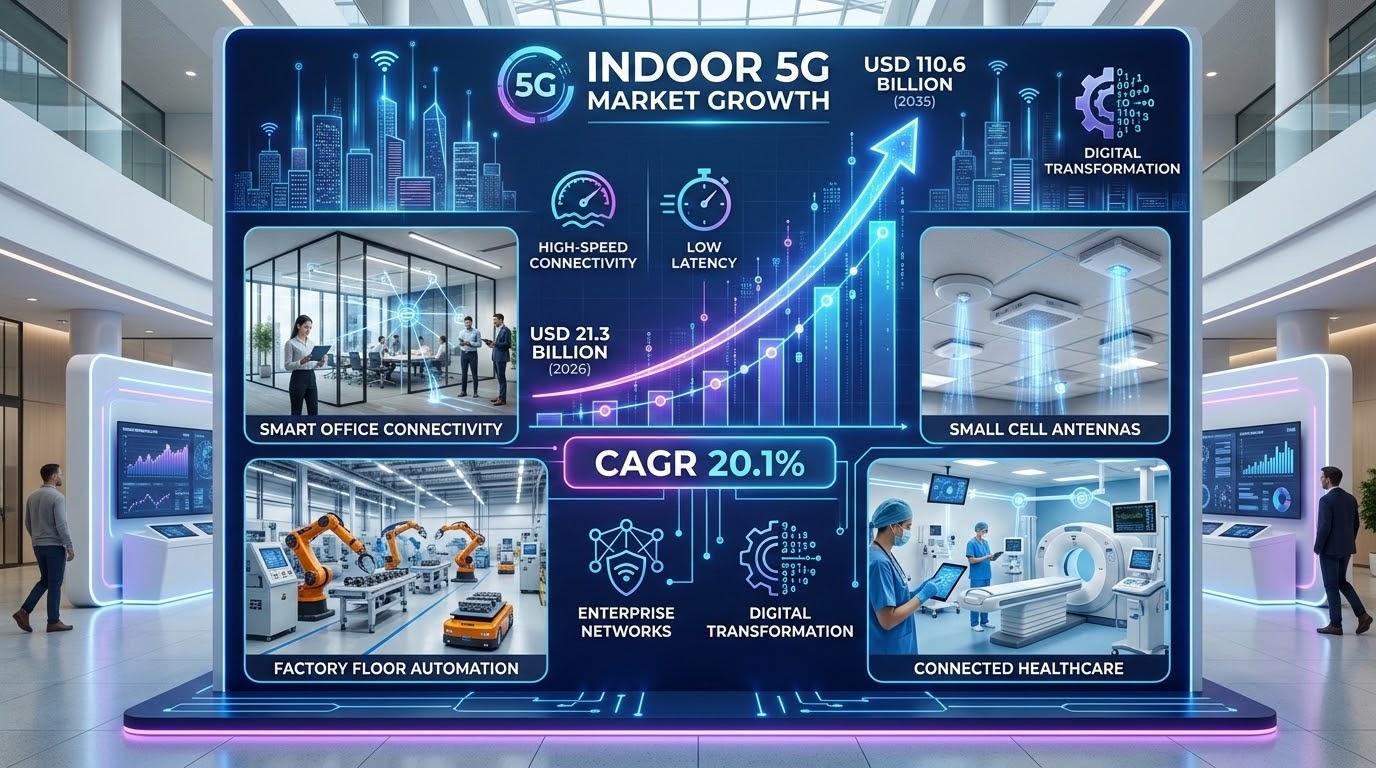
According to Dimension Market Research, the global Indoor 5G Market is expected to reach USD 21.3 billion in 2026 and expand at a CAGR of 20.1% through 2035, reaching USD 110.6 billion, driven by rising enterprise connectivity demand, private 5G networks, smart buildings, indoor wireless broadband, and high capacity in-building mobile network infrastructure.
Indoor 5G refers to the deployment of fifth generation mobile network technology inside buildings and enclosed environments to deliver ultra-fast data speeds, low latency, high device density and reliable wireless coverage where outdoor macro networks struggle to penetrate. It uses purpose-built indoor radio systems such as small cells and distributed antenna networks combined with local core and edge computing to support demanding digital workloads including real-time collaboration, immersive media, automation, connected machines and secure enterprise communications across offices, hospitals, factories, campuses and public venues.
The global Indoor 5G market represents the worldwide ecosystem of technologies, solutions and services that enable high-performance wireless connectivity inside commercial, industrial and institutional buildings. It includes radio access infrastructure, spectrum optimized indoor networks, software platforms, edge computing and professional services that together allow enterprises and property owners to deploy private and managed 5G environments. Growth is being driven by the rapid digitization of workplaces, rising demand for smart buildings, increasing use of cloud applications and the need for reliable high-capacity wireless networks that support thousands of connected devices simultaneously.
From a market perspective, global indoor 5G adoption is expanding as enterprises seek greater control over network security, quality of service and data localization while reducing dependence on traditional public cellular coverage. Industries such as manufacturing, healthcare, logistics, retail and education are increasingly investing in indoor wireless broadband to enable automation, real-time analytics, connected equipment, digital twins and immersive experiences. As spectrum availability improves and network virtualization advances, the indoor 5G market is evolving into a core layer of modern enterprise infrastructure, supporting next-generation digital transformation across regions and verticals.
Definition and Market Significance
Indoor 5G refers to the deployment of fifth-generation (5G) mobile network infrastructure inside buildings and enclosed environments to deliver ultra-fast data speeds, low latency, high device density, and reliable wireless coverage where outdoor macro networks struggle to penetrate. It utilizes purpose-built radio systems such as small cells, distributed antenna systems (DAS), and repeaters, combined with local core and edge computing capabilities.
The importance of indoor 5G lies in its ability to support demanding digital workloads—including real-time collaboration, immersive media, industrial automation, connected machines, and secure enterprise communications—across offices, hospitals, factories, campuses, and public venues. It provides the high-capacity, low-latency connectivity required for modern applications that cannot be effectively served by traditional Wi-Fi or outdoor cellular networks.
Indoor 5G also supports broader digital transformation initiatives by enabling private networks that offer enterprises greater control over security, data localization, and quality of service. It serves as a foundational layer for smart buildings, industrial IoT, and next-generation enterprise infrastructure.
Request a Complimentary PDF Sample
https://dimensionmarketresearch.com/request-sample/indoor-5g-market/
Market Drivers
A major factor driving the Indoor 5G Market is enterprise digital transformation and private connectivity demand. Rapid digital transformation initiatives across industries are driving adoption of indoor 5G networks to support high-throughput connectivity, secure enterprise communication, and real-time data processing. Organizations increasingly favor private 5G solutions over traditional Wi-Fi to enable seamless cloud application access, edge computing integration, and high device density coverage in offices, campuses, and factories.
The growth of industrial IoT and automation is another key driver supporting market expansion. The proliferation of industrial IoT devices, robotics, and automated systems in manufacturing and logistics is accelerating demand for reliable in-building wireless networks. Indoor 5G's ultra-low latency and robust wireless performance make it ideal for mission-critical applications such as predictive maintenance, autonomous guided vehicles, and connected sensors, enhancing operational efficiency and reducing downtime.
The increasing demand for high-capacity indoor wireless broadband in smart buildings, healthcare facilities, and public venues is also contributing to market growth, as organizations seek to support thousands of connected devices simultaneously with consistent performance.
Market Trends
The integration of indoor 5G with edge computing and AI-driven networks is emerging as an important trend. Indoor 5G networks are increasingly integrated with multi-access edge computing (MEC) and artificial intelligence for real-time network optimization, enhanced security, and localized data processing. This trend enhances performance for latency-sensitive applications, supports distributed analytics, and enables adaptive resource allocation based on traffic patterns.
Neutral host and shared infrastructure models are another significant trend. Neutral host models, where multiple operators and enterprises share indoor 5G infrastructure, are gaining traction in high-density venues such as airports, stadiums, and convention centers. Shared wireless infrastructure lowers deployment costs, improves spectrum utilization, and ensures consistent high-capacity coverage for multiple stakeholders in complex environments.
The shift toward private enterprise networks is also transforming the market, as organizations increasingly want full control over their indoor 5G environments to meet specific performance, security, and data governance requirements.
Market Restraints
Despite its strong growth potential, the indoor 5G market faces certain limitations. High deployment and infrastructure costs remain a major restraint. The initial investment required for indoor 5G infrastructure, including small cells, distributed antenna systems, and core network integration, is significant. The complexity of indoor wireless coverage planning, spectrum licensing fees, and professional services increases total cost of ownership, slowing adoption in cost-sensitive segments.
Technical challenges with network integration also pose significant hurdles. Integrating indoor 5G with existing IT networks and legacy systems poses challenges related to interoperability, spectrum management, and security. Ensuring seamless handover between outdoor and indoor networks while maintaining quality of service requires advanced network planning and expertise, limiting rapid deployment for some organizations.
In addition, the availability of spectrum and regulatory complexities across different regions can slow the pace of deployment and increase operational costs.
Market Opportunities
Private 5G as a service and managed connectivity solutions present a significant market opportunity. Offering private 5G networks through managed services allows service providers and system integrators to help enterprises reduce operational burden, accelerate time to value, and scale wireless capacity based on evolving business needs. This model is particularly attractive for organizations looking to outsource deployment, maintenance, and optimization.
Expansion into emerging vertical use cases is another promising opportunity. New applications in smart healthcare, AR/VR collaboration, immersive media, and real-time analytics open opportunities for indoor 5G adoption beyond traditional commercial and industrial sectors. Hospitals, educational campuses, and smart retail environments are increasingly deploying indoor wireless broadband to support advanced digital services and improve user experience.
Furthermore, the growth of smart cities and digital infrastructure investments in developing regions is expected to open new opportunities for the indoor 5G industry, as governments and enterprises invest in next-generation connectivity.
Segmentation
The Indoor 5G Market is categorized based on network architecture, spectrum band, network ownership model, deployment environment, solution layer, and application type.
By network architecture, small cell networks are expected to dominate the segment with a 56.0% share in 2026 because they offer a highly flexible and cost-effective way to deliver high-capacity indoor 5G coverage across offices, factories, hospitals, and commercial complexes. These compact radio units can be easily installed throughout a building to provide strong in-building signal strength, low latency, and seamless mobility.
By spectrum band, Sub-6 GHz spectrum is anticipated to dominate with a 74.0% share in 2026 because it provides the best balance between coverage, penetration, and capacity for indoor environments. These frequencies travel more effectively through walls, floors, and building materials compared to higher bands.
By network ownership model, private enterprise networks are expected to dominate with a 52.0% share in 2026 because organizations increasingly want full control over their indoor 5G environments to meet specific performance, security, and data governance requirements.
By deployment environment, commercial real estate is expected to dominate with a 36.0% share in 2026 as offices, business parks, shopping malls, hotels, and mixed-use developments increasingly rely on high-performance indoor wireless connectivity.
By solution layer, radio access infrastructure is expected to dominate with a 46.0% share in 2026 because it forms the physical foundation of every indoor 5G network, including small cells, antennas, radio units, and distributed antenna components.
By application type, high-density connectivity is expected to dominate with a 29.0% share in 2026 as indoor environments increasingly need to support large numbers of simultaneous users and connected devices.
Regional Analysis
Asia Pacific is expected to lead the global Indoor 5G market with a 38.0% revenue share in 2026, driven by rapid digitalization, large-scale 5G infrastructure investments, and strong demand from manufacturing, smart buildings, and enterprise connectivity across countries such as China, Japan, South Korea, and India. The region has a high concentration of technology-intensive industries, dense urban development, and growing adoption of private 5G networks in factories, logistics centers, and commercial complexes. Government initiatives supporting 5G rollout, smart city programs, and industrial automation are further accelerating indoor 5G deployments.
North America is emerging as a region with significant growth, supported by strong enterprise adoption, widespread deployment of private 5G networks, and advanced cloud and edge computing infrastructure. The US market is expected to reach USD 6.3 billion in 2026 at a CAGR of 18.8%. Large investments by telecom operators, neutral host providers, and technology companies are accelerating indoor wireless upgrades across offices, healthcare facilities, industrial plants, and public venues.
Europe is experiencing steady growth, with the market expected to reach USD 5.9 billion in 2026 at a CAGR of 15.0%. Demand is rising across commercial offices, retail complexes, healthcare facilities, and public venues where reliable mobile broadband and low-latency networks are essential for digital operations. Supportive spectrum policies and strong emphasis on data protection and network reliability are further strengthening Europe's position.
Japan is positioned as one of the fastest-growing indoor 5G markets in the Asia Pacific region, with the market expected to reach USD 2.0 billion in 2026 at a CAGR of 20.0%. Strong demand from manufacturing, electronics, healthcare, and commercial real estate sectors is driving investments in high-performance in-building wireless networks.
Competitive Landscape
The competitive landscape of the global Indoor 5G market is characterized by intense innovation, strategic partnerships, and a strong focus on integrated network solutions that combine radio infrastructure, software platforms, and managed services. Market participants compete on the basis of network performance, deployment flexibility, spectrum efficiency, and the ability to support private and hybrid 5G environments for enterprises.
Prominent players include Ericsson, Huawei Technologies, Nokia, Samsung Electronics, ZTE Corporation, CommScope, Corning Incorporated, Comba Telecom, AT&T, Airspan Networks, SOLiD, Dali Wireless, Nextivity, JMA Wireless, Liteon Technology, ALCAN, Extenet Systems, Mavenir, Boingo Wireless, and Cisco Systems. Recent developments include Inseego's launch of an advanced indoor 5G fixed wireless access router (December 2025), Ericsson's introduction of a new compact indoor 5G radio solution (October 2025), and Airspan Networks' acquisition of Corning's Wireless business (April 2025).
Technological Advancements
Rapid advancements in small cell technology, distributed antenna systems, and edge computing are transforming the indoor 5G market. Compact, high-capacity radio units enable flexible deployment in diverse indoor environments, while integration with multi-access edge computing enables real-time data processing and low-latency applications.
AI-driven network management platforms are also playing a significant role, optimizing spectrum allocation, power levels, and handovers based on real-time traffic patterns and user behavior. These advancements improve coverage quality, reduce interference, and enable predictive maintenance of indoor 5G infrastructure.
Consumer Adoption Patterns
Enterprises across manufacturing, healthcare, logistics, retail, commercial real estate, and education are increasingly adopting indoor 5G to support automation, real-time analytics, connected equipment, and immersive experiences. The growing availability of private 5G networks and managed indoor solutions is making this technology more accessible to organizations of all sizes.
Regulatory Environment
Regulatory bodies across different regions, including the FCC in the United States, the European Commission, and national telecom authorities in Asia Pacific, establish spectrum allocation policies, licensing frameworks, and deployment guidelines for indoor 5G. Supportive spectrum policies, shared access models, and government initiatives for digital infrastructure are shaping the market landscape.
Market Challenges
The indoor 5G market faces challenges related to high deployment costs, technical integration complexity, spectrum availability, and the need for specialized expertise. Additionally, ensuring seamless interoperability between indoor and outdoor networks, managing multiple vendor environments, and addressing security concerns create operational complexities for enterprises and service providers.
Future Outlook
The future of the Indoor 5G Market remains highly promising as enterprises continue to digitize operations and demand high-performance wireless connectivity inside buildings. Increasing adoption of private 5G networks, expansion into emerging verticals, integration with edge computing and AI, and growth in smart buildings and industrial automation are expected to drive strong market growth during the forecast period.
FAQs
What is the expected size of the Indoor 5G Market in 2026?
The market is expected to reach USD 21.3 billion in 2026.
What is the projected market value by 2035?
The market is forecast to reach USD 110.6 billion by 2035.
What is the CAGR of the Indoor 5G Market?
The market is expected to grow at a CAGR of 20.1% during 2026–2035.
Which network architecture segment dominates the market?
Small cell networks are expected to dominate with a 56.0% share in 2026.
Which region leads the global indoor 5G market?
Asia Pacific is expected to lead with a 38.0% revenue share in 2026.
Summary of Key Insights
The global Indoor 5G Market is expected to grow from USD 21.3 billion in 2026 to USD 110.6 billion by 2035, recording a CAGR of 20.1% during the forecast period. Small cell networks lead the network architecture segment with 56.0% share, while Sub-6 GHz spectrum dominates with 74.0% share. Private enterprise networks lead ownership models with 52.0% share, and commercial real estate leads deployment environments with 36.0% share. Radio access infrastructure leads solution layers with 46.0% share, and high-density connectivity leads applications with 29.0% share. Asia Pacific holds the largest regional share with 38.0% of global revenue in 2026. The US market is projected to reach USD 29.7 billion by 2035 at a CAGR of 18.8%.
Purchase the Full Report
https://dimensionmarketresearch.com/checkout/indoor-5g-market/

 English
 Arabic
 Spanish
 Portuguese
 Deutsch
 Turkish
 Dutch
Dutch
 Italiano
 Russian
 Romaian
 Portuguese (Brazil)
 Greek
Greek