
Why Indian Students Are Choosing MBBS Admission in Russia Over Expensive Private Colleges at Home
Every year, thousands of NEET-qualified Indian students face the same wall—government seats are gone, and private college fees in India are touching ₹80 lakhs to ₹1 crore. That is exactly the moment when MBBS Admission in Russia starts making real sense. Not as a compromise, but as a smart, calculated decision that over 20,000 Indian students are already living out successfully.
Why Are So Many Indian Students Choosing MBBS in Russia?
Russia has been training medical professionals for over a century. Today, it has more than 60 government medical universities that are recognized by the National Medical Commission (NMC), the World Health Organization (WHO), and international bodies like FAIMER and ECFMG. These are not obscure institutions—these are established Russian medical universities with proper infrastructure, faculty, and global recognition.
The honest answer to "why Russia" is simple: the combination of affordable fees, a valid degree, and no donation or capitation fee adds up in a way that very few other countries can match. Students placed in Russia through reputed consultancies like Meta Education India get access to NMC-approved universities starting at annual fees of just ₹2.5 lakhs.
Eligibility Criteria for MBBS in Russia
Compared to the complicated domicile rules and quota systems of Indian state counseling, Russian university eligibility is refreshingly clear:
-
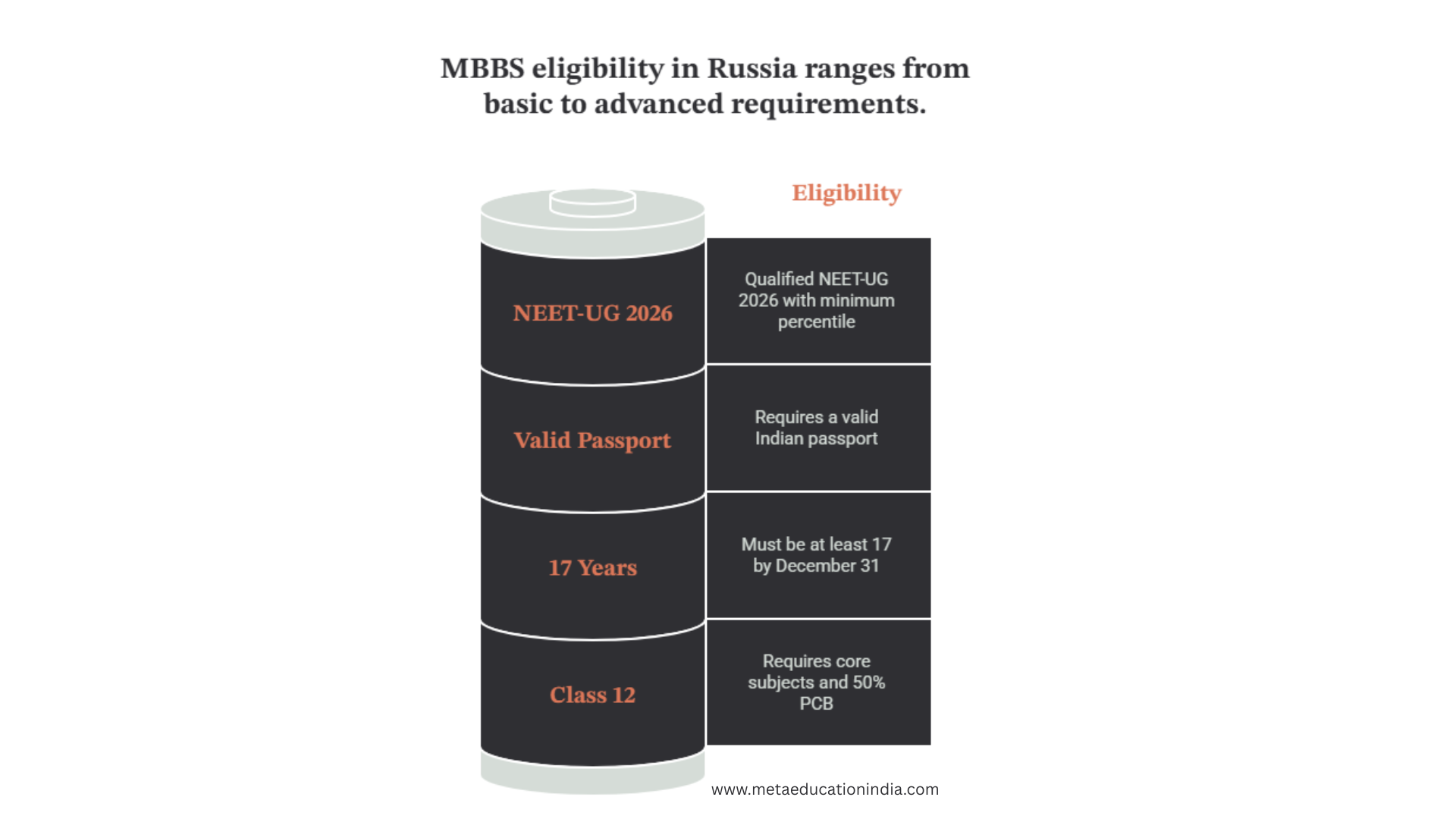
Passed Class 12 with Physics, Chemistry, Biology, and English as core subjects
-
Minimum 50% marks in PCB in Class 12
-
Qualified NEET-UG 2026 with at least the minimum qualifying percentile
-
Must be at least 17 years old by December 31 of the admission year
-
Valid Indian passport
One important point: NEET is not required because Russian universities demand it. It is required because the NMC mandates NEET qualification for Indian students to be eligible for the FMGE/NExT licensing exam when they return home. Without NEET, you cannot legally practice medicine in India after your degree—regardless of which university you attended.
Honest Breakdown of Cost of MBBS in Russia
This is where most students get confused because agents quote only tuition fees. Here is the cost of an MBBS in Russia in full:
Tuition fees at mid-range NMC-approved universities run approximately ₹2.5 to ₹4.5 lakhs per year. At premium universities, this goes up to ₹4.5 to ₹7 lakhs annually. Over six years, total tuition comes to roughly ₹15 to ₹42 lakhs depending on the institution.
MBBS fees in Russia for Indian students beyond tuition include hostel accommodation (₹60,000 to ₹1 lakh per year), food and personal expenses (₹80,000 to ₹1.2 lakhs per year), and health insurance plus miscellaneous costs (₹30,000 to ₹50,000 per year).
All-in, most Indian students spend between ₹4 and ₹8 lakhs per year, making the six-year total anywhere from ₹25 to ₹40 lakhs. Compare that to ₹80 lakhs to ₹1 crore for a private MBBS seat in India—the math speaks for itself.
If anyone — agent or institution — is asking for extra "seat charges" beyond official Russia MBBS fees, that is a red flag. Legitimate NMC-approved government universities do not charge capitation fees.
Top 10 Russian Medical Colleges Indian Students Should Know About
Choosing the right university matters—not just for fees, but for FMGE pass rates and overall experience. Here is a reliable list of MBBS colleges in Russia that Indian students frequently enroll in:
-
I M Sechenov First Moscow State Medical University — Among the oldest and most reputed Russian Medical University options
-
Kazan State Medical University — Strong clinical training, good FMGE track record
Other NMC-approved options include Tver State Medical University, Omsk State Medical University, Pacific State Medical University, Ulyanovsk State Medical University, Far Eastern State Medical University, and several others across different cities.
When comparing top university MBBS fees in Russia, always cross-check the NMC recognition list before finalizing.
What Six Years Actually Looks Like Inside a Russian Medical College
Understanding the structure of MBBS in Russia helps you plan realistically:
The first two years are dedicated to basic sciences—anatomy, physiology, biochemistry, and histology. Alongside your medical subjects, you begin learning the Russian language, which becomes critical in later years.
Third year is the paraclinical phase—Pathology, Pharmacology, Microbiology, and Pathophysiology. This is also when smart students begin India-oriented FMGE preparation alongside their regular coursework.
Years four through six are fully clinical. You enter hospital wards, interact with real patients, and rotate through surgery, internal medicine, obstetrics and gynecology, pediatrics, and psychiatry. Patient communication happens in Russian—students who ignored language classes in years 1 and 2 seriously struggle here.
Final state exams lead to the MD (Doctor of Medicine) degree—internationally recognized and equivalent to MBBS in India.
Step-by-Step Guide to Securing Your Seat for 2026 Admissions
MBBS Admissions in Russia for 2026 follow a clear process. Applications typically open between June and September:
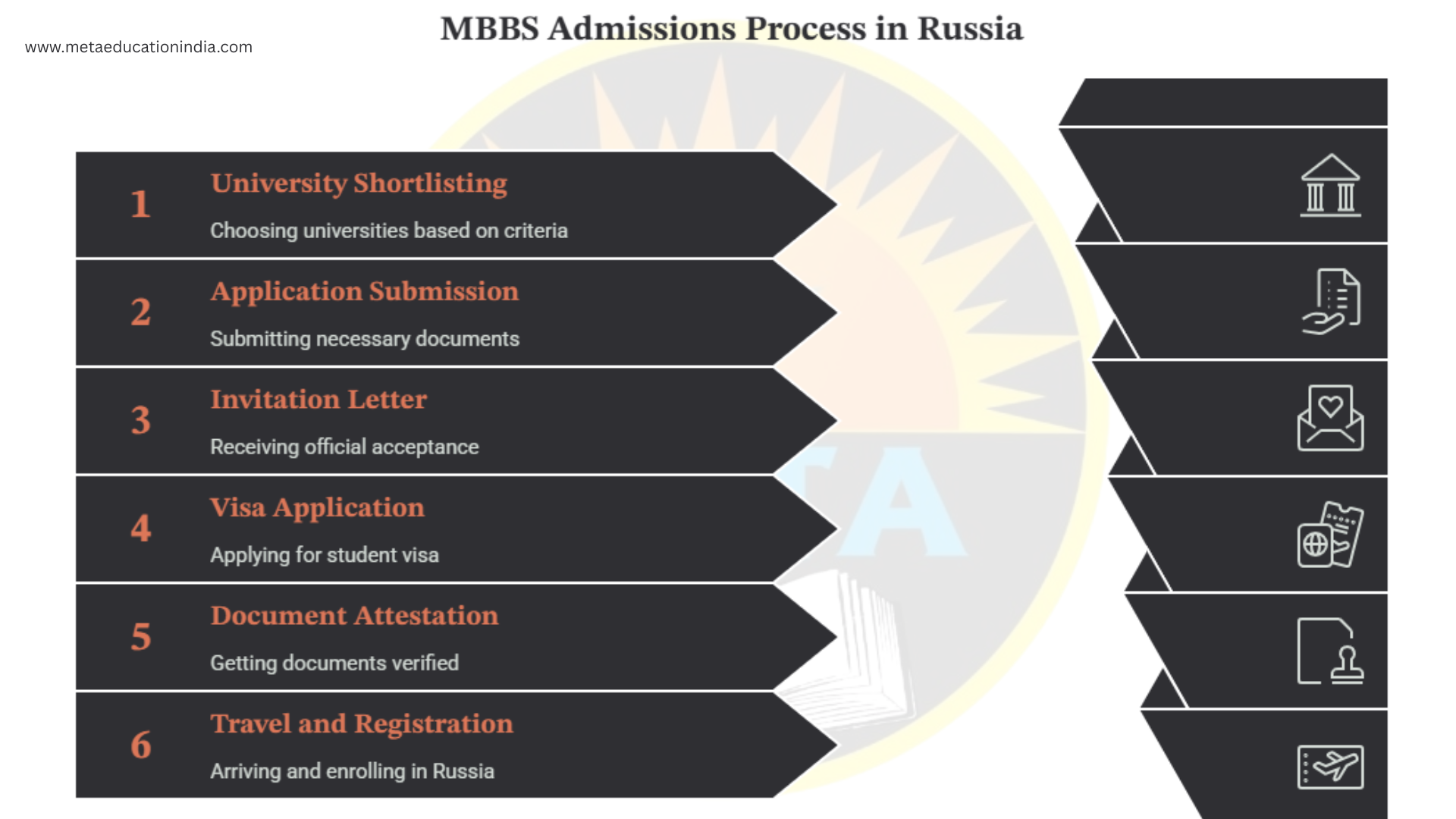
Step 1 — Confirm your NEET-UG 2026 score and keep the scorecard ready.
Step 2 — Shortlist 2 to 3 NMC-approved universities based on your budget and preferred city. Compare top university MBBS fees in Russia carefully.
Step 3 — Submit your application with required documents: Class 10 and 12 mark sheets, passport copy, NEET scorecard, and passport-size photographs.
Step 4 — Receive the official Invitation Letter from the university upon acceptance. This document is mandatory for your Russian student visa.
Step 5 — Apply for your student visa at the Russian Embassy or Consulate. Attach the Invitation Letter, medical fitness certificate, and HIV test report.
Step 6 — Get your Class 10, Class 12, and NEET documents attested by the HRD Ministry and Russian Embassy.
Step 7 — Travel to Russia, complete university registration, pay your first-year fees, and begin classes in September.
The FMGE and NExT Truth That Most Agents Will Not Tell You
This is the most important part of this entire article.
After completing your degree from any Russian medical university, you cannot practice medicine in India without clearing the Foreign Medical Graduate Examination (FMGE)—which is transitioning to the NExT (National Exit Test). This exam is conducted by the National Board of Examinations and tests clinical knowledge in an Indian medical context.
The historical pass rate for FMGE has been approximately 15 to 20 percent per attempt. That means in any given session, roughly 80 percent of candidates do not clear it on the first try. This is not a reflection of Russian medical education quality — it is a reflection of how differently the two systems approach clinical reasoning and examination.
Students who start India-specific preparation using resources like Marrow or PrepLadder from Year 3 onwards — running parallel to their Russian curriculum — consistently perform better at FMGE. Those who leave it for after graduation often spend years trying to clear it.
Any consultant who promises guaranteed FMGE clearance or quotes A 90 percent pass rate is giving you false information. Plan for 6 to 12 months of focused post-graduation preparation before your licensing attempt.
Practical Realities of Student Life in Russia
Weather: Russian winters are serious. Cities like Moscow, Orenburg, and Arkhangelsk regularly see temperatures of -15°C to -25°C in January and February. Budget for proper thermal gear before you leave—this is not optional.
Monthly expenses: Most students spend between $150 and $300 per month on food, transport, and personal needs. University hostel accommodation is affordable and secure.
Indian student community: Every major Russian medical university with a significant Indian student population has active Indian communities. Festivals are celebrated, food options are available, and peer support is strong.
Language: Russian language learning is woven into the curriculum from Year 1. Take it seriously. By Year 4, when you are on hospital wards, your ability to communicate with patients in Russian directly affects your clinical learning.
Should You Choose Russia? An Honest Assessment
Russia is a strong choice if:
-
You are NEET-qualified but missed government seats in India
-
Your total budget for the full course is ₹25 to ₹40 lakhs
-
You are prepared to learn Russian language seriously
-
You will start FMGE/NExT preparation from Year 3
-
You want a degree with international recognition for future options like USMLE or PLAB
Reconsider if:
-
You have not cleared NEET at all
-
You expect to return and practise immediately without any licensing exam
-
You are not prepared for cold climate and significant cultural adjustment
Wrapping Up
MBBS in Russia is not a shortcut — it is an alternative route that works well for students who go in prepared. The best medical colleges in Russia offer solid medical education at a fraction of what Indian private colleges charge, with no hidden donations and internationally valid degrees.
Choose your university carefully from the list of MBBS colleges in Russia that are NMC-approved. Understand the full Cost of MBBS in Russia before committing. Take Russian language and FMGE preparation seriously from the beginning. And work with a reliable consultancy that gives you accurate information rather than just telling you what you want to hear.
For complete details on MBBS fees in Russia for Indian students, university comparisons, and 2026 admission guidance, visit Meta Education India.

 English
 Arabic
 French
 Spanish
 Portuguese
 Deutsch
 Turkish
 Dutch
Dutch
 Italiano
 Russian
 Romaian
 Greek
Greek