
Industrial Lifting Without Compromise: The Advantages of 10t+10t Gantry Cranes
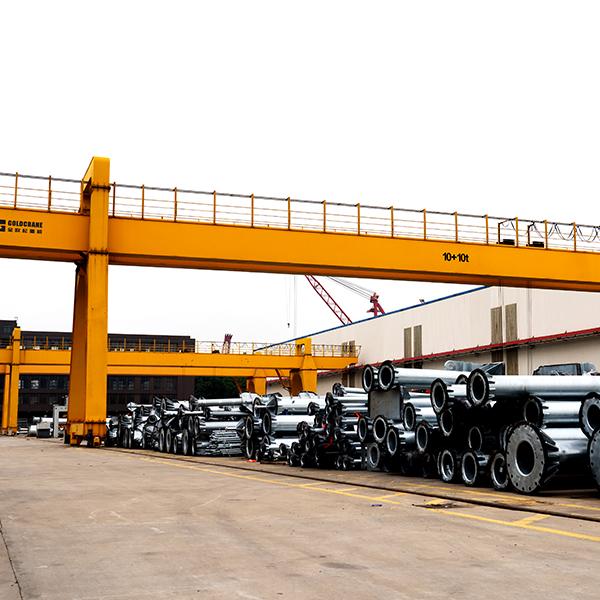
In heavy industrial material handling, crane selection is rarely determined by lifting capacity alone. Structural design, load behavior, duty cycle, and environmental conditions all play a decisive role in overall equipment performance and operational safety.
The 10t+10t Double-Girder Gantry Crane is a configuration developed for medium-to-heavy lifting applications where dual-hoist coordination, distributed load handling, and high structural rigidity are required. Unlike single-hoist systems, this design introduces significantly greater operational flexibility while maintaining strong mechanical stability through a double-girder framework.
⚙️ Dual-Hoist Configuration and Load Behavior
A defining feature of the 10t+10t gantry crane system is its dual independent hoisting units, each rated at 10 tons. These hoists can be operated in multiple modes depending on operational requirements:
- 🧩 Independent operation for separate lifting tasks
- ⚖️ Synchronous operation for balanced load lifting
- 🔗 Coordinated movement for long or irregular structures
From an engineering standpoint, dual-hoist systems improve load distribution by minimizing localized stress concentration at a single lifting point.
📦 Typical handling scenarios include:
- Long steel beams
- Large prefabricated structural assemblies
- Irregular industrial equipment modules
- Multi-point lifting in fabrication workshops
By distributing force across two lifting points, the system reduces deformation risk in both the load and crane structure, improving safety and precision.
🏗 Structural Characteristics of Double-Girder Design
The double-girder configuration is widely adopted in heavy-duty cranes due to its superior mechanical stability under both static and dynamic loads.
Compared with single-girder systems, double-girder gantry cranes offer:
- 📈 Higher torsional rigidity
- 📏 Improved span stability
- ⚖️ Better load distribution across the structure
- 📉 Reduced mid-span deflection
In outdoor environments—where cranes face wind load, uneven ground, and temperature variation—structural stiffness becomes a critical performance factor.
🧱 Structural load division:
- Upper structure: trolley system, hoisting units, power transmission
- Lower gantry structure: rail movement and load transfer stability
This separation of mechanical responsibilities ensures smoother operation under high-load and high-frequency working conditions.
🏭 Industrial Application Scenarios
The 10t+10t Double-Girder Gantry Crane is commonly used in environments where material geometry and weight distribution are highly variable.
📍 Key industries include:
- Steel fabrication and processing yards
- Precast concrete production plants
- Shipbuilding and marine maintenance facilities
- Large-scale construction logistics zones
- Industrial storage and assembly areas
- Port auxiliary lifting operations
In such environments, load conditions are rarely uniform. Dual-hoist systems allow operators to adjust lifting points dynamically instead of forcing materials into rigid handling configurations.
⚡ Operational Stability and Dynamic Load Control
One of the main technical challenges in gantry crane operation is controlling dynamic forces during acceleration, deceleration, and load positioning.
For a 10t+10t dual-hoist system, stability depends on:
- Hoist synchronization accuracy
- Load swing suppression
- Controlled acceleration and braking
- Structural vibration response
If synchronization is not properly maintained, risks may include:
- Uneven load distribution
- Load tilting during lifting
- Structural stress concentration
- Reduced positioning accuracy
To address this, modern systems typically integrate:
- Variable frequency drive (VFD) control systems
- Load monitoring sensors
- Anti-sway control algorithms
👉 From an engineering perspective, stability is achieved not only through structure but also through intelligent motion control coordination.
🌦 Environmental Factors in Outdoor Operation
Unlike overhead cranes in controlled indoor environments, gantry cranes operate in open industrial settings where external conditions significantly affect performance.
🌍 Key environmental challenges:
- Wind load affecting suspended materials
- Thermal expansion and contraction of steel structures
- Uneven ground and rail alignment deviations
- Corrosion in coastal or industrial environments
Double-girder structures are preferred in such scenarios due to their higher rigidity and reduced sensitivity to external disturbances.
🔧 Long-term maintenance focus includes:
- Structural weld inspection
- Rail alignment calibration
- Corrosion protection systems
- Fatigue stress monitoring
🛡 Safety Logic in Dual-Hoist Systems
Dual-hoist configurations introduce additional control complexity, requiring enhanced safety logic systems.
🔐 Standard safety systems include:
- Overload protection mechanisms
- Limit switch coordination
- Anti-sway control systems
- Emergency stop integration
- Load balancing feedback loops
The key objective is not only preventing overload but ensuring symmetrical and stable load behavior during synchronized lifting operations.
When properly engineered, dual-hoist systems can actually improve safety by reducing reliance on single-point lifting for oversized or unstable loads.
🧠 Engineering Considerations in Crane Selection
Choosing a 10t+10t Double-Girder Gantry Crane is not based solely on lifting capacity. Instead, it depends on multiple engineering and operational factors:
- Maximum load geometry and shape complexity
- Required lifting span and travel range
- Frequency of dual-load operations
- Site layout and workspace constraints
- Duty cycle classification and workload intensity
In many cases, dual-hoist systems are selected for operational flexibility rather than higher tonnage requirements.
🏢 Goldcrane Engineering Perspective
Within industrial crane manufacturing, Goldcrane focuses on structural engineering principles and long-term operational reliability of gantry crane systems used in heavy-duty environments.
🏗 Core engineering priorities include:
- Structural stress distribution optimization
- Dynamic load behavior analysis
- Weld integrity and fatigue resistance
- Multi-directional force stability
- Outdoor environmental adaptability
From this perspective, the 10t+10t Double-Girder Gantry Crane is not simply a lifting device—it is a coordinated mechanical system integrating structure, motion control, and load management engineering.
📌 Conclusion
The 10t+10t Double-Girder Gantry Crane is engineered for industrial environments where lifting tasks involve:
- Complex load geometries
- Frequent handling cycles
- Outdoor operational conditions
- High stability requirements
Its core value lies in:
- ⚖️ Dual-hoist load distribution capability
- 🏗 High structural rigidity of double-girder design
- 🔄 Flexible handling of variable industrial loads
- 📊 Stable performance under dynamic working conditions
Rather than being defined only by tonnage, this crane represents a complete engineering solution for complex material handling systems.
Goldcrane continues to develop gantry crane systems based on these principles, focusing on structural stability, operational consistency, and real-world industrial application demands.
https://www.goldcraneglobal.com/the-advantages-of-10t-10t-gantry-cranes.html

 Arabic
 French
 Spanish
 Portuguese
 Deutsch
 Turkish
 Dutch
Dutch
 Italiano
 Russian
 Romaian
 Portuguese (Brazil)
 Greek
Greek